Saturday, 18 February 2017

capital ring 5

     Best laid schemes... We had to cancel a couple of dates over the weekend as the weather was vile, but we managed to arrange one quickly for Tuesday when the weather seemed to be opening up. And in the event it turned out perfect for a walk for me, Ian and Gail across a switchback of south London ridges and hills.
     Picking up at Beckenham Place Park, we passed its once fine Palladian mansion, now rather neglected by Lewisham council.  A lot of the walk today turned out to be through prosperous districts - the classic 'leafy suburbs' - with fine detached houses, mature trees but little else.  No shops for miles.  Front gardens, no doubt once full of wisterias and camellias, are now almost entirely paved over for the obligatory flash motors.  But it was a pleasant enough walk along quiet streets, one or two nice churches on the way.  We were high up on a ridge, with distant views of the city and the north downs in opposite directions, almost lost in a sun drenched haze.
     A couple of parks, then down into Penge; and up again under many railway viaducts to Sydenham Hill, the site of Crystal Palace.  This vast building was moved lock stock and barrel in the 1850s from Kensington Gardens, and the hill laid out as pleasure gardens, which survive, although the palace burnt down spectacularly in 1936.
    An ornamental lake features a series of dinosaur statues, part of the Victorian ethos of worthy educational leisure pursuits.  Modern day activities here turn more to the sporting, with the running track and swimming pool in the shadow of the huge TV transmitter.
    On past the elegant station, with a great little independent cafe, to Upper Norwood, with its attractive mix of regency and late Victorian houses and commercial buildings, then we followed the route through Westow Park as it cascades sharply down, through a wide recreation ground, back along the ridge, and then into Biggin Wood, a little wild remnant surrounded by allotments.  A couple more treats, much better looked after by respectively Croydon and Lambeth councils: Norwood Grove, a country house built by the founder of P&O; and then The Rookery - the garden of a lost Victorian guest house and spa, with mature cedars and massed shrubbery, where Queen Victoria came to take the waters.  Streatham, a spa? There's another little independent cafe here, full this half term of rioting small children and ineffecive parenting.  But the final stretch descends through Streatham Common, a long barren grassed area leading down to the High Road, with a few forlorn looking trees: its only interest being that nine paintings stolen from Dulwich Picture Gallery were found here.  Funnily enough, today we also passed near where the stolen World Cup was found in 1966 by Pickles, the collie.
     Plans for this weekend look to be off too, as next day I came down with a vicious bout of gout.  Anyway, we have reached the half way point and will carry on soon.

Wednesday, 8 February 2017

capital ring 4


     Gail and I decided to brave it for the fourth leg, despite forecasts of rain, but we managed to complete it in blustery but mostly sunny weather.  This took us from Eltham Park through a series of mostly playing fields to Eltham Palace itself.  This was once a royal palace, favoured by Kings John and Henry VIII, with traces of the moat and old stone walls, surviving medieval outbuildings and a tilt yard, but it was wrecked during the civil war and abandoned until the Courtauld family took it on and turned it into an art deco masterpiece.  One for the list of places to revisit in the summer. 
     We continued along King John's Walk, an ancient track that led from the palace to royal hunting grounds to the south, that passes through an area of stables and fields with horses and ponies in winter coats.  These and the golf courses reflect the relative prosperity of these classic 'leafy suburbs'.  Part of this path has been renamed the Railway Children's Walk as it features in E. Nesbit's book - she lived in the area.  There is a very well kept nature reserve at Grove Park. 
     From here, we descended into extensive garden city-style 1920s LCC council estate.  They are quite well laid out with wide avenues of mature trees between the houses, and the planners thoughtfully kept a series of old woodland walks at the backs of the houses, which we followed for over a mile.  This brought us to Beckenham Place Park and, with a squall rapidly approaching we made it to the station for a Thameslink train to St Pancras.

Sunday, 29 January 2017

capital ring 3


     Another good day for a walk as we picked up where we left off.  Our third walk turned out to be through spectacular woods, commons and hills, part of the Green Chain of footpaths of south-east London that the Capital Ring joins for a while. 
     The first mile or so from Albert Dock turned out to be rather dreary, through dispiriting housing estates and one of the Thames's less interesting reaches, dominated by the Tate and Lyle sugar factory.  However the weather was promising with brilliant cloud effects, and we soon turned off busy roads into the first of a series of parks.  Maryon and Maryon Wilson parks are fairly wild with heavily wooded valleys, leading to the more open Charlton Park.  These were all once part of the estate of Charlton House, a beautiful Jacobean manor house now carefully restored, probably the finest within the bounds of London.  Rising all the time, the open spaces continue: via a small park we accessed the wide expanse of Woolwich Common, with big open views back to the river.  This area was all a major military area at one time, home of the Royal Artillery and the famous Arsenal.   The common served as army training grounds. 
     From there, up again, to Shooters Hill and the first of a series of woods, remnants of ancient forest that once covered these steep slopes.  The main road to Canterbury and Dover has passed through here since Roman times, and this area was frequented by highwaymen once upon a time.  In the middle we came upon Severndroog Castle - really just a Gothick folly, a memorial to an 18th century East India Company man, whose house once stood below it, with a tremendous view to the south and the Downs.  We continued through Oxleas Wood then into a clearing where there is a very welcome cafe very popular with dogwalkers.  The final couple of miles took us down into Shepherdleas Woods and Eltham Park, as the sky started to fill with a glorious golden late afternoon glow.  This otherwise beautiful park, again heavily wooded, is bisected by an extremely noisy arterial road, the A2 from Dover, which I've travelled along many times without realising what lies either side of it.  We circumnavigated the park, and just as rain started to fall made a quick dash to Falconwood station.

Thursday, 26 January 2017

capital ring 2

     Another brilliantly sunny but even colder day, 2 days later on the Sunday, and we are off with Gail again for the second leg of our epic tour d'horizon.
     This second leg took us from Hackney Wick through the Olympic park, coming together now nicely as a great resource for East London, the largest new park in London since the 19th century. From there we took the Greenway, a long straight raised walkway that takes you out into the further reaches of east London, through Plaistow and to Beckton.  If I'm honest this stretch holds much less interest than the first.  It is a linear park built over London's main sewer outfall, though much more pleasant than this sounds (apart from occasional whiffy hints).  There are some wide views back to Canary Wharf and to Woolwich and Shooters Hill to the south.  On the way you pass Bazalgette's magnificent Abbey Mills pumping station, built in 1868 in a florid eclectic style and nicknamed the Cathedral of Sewage by some wag.  Also some of the tidal creeks that lead to the Thames.
     At Beckton we turned south through a few pleasant suburban parks, eventually to Albert Dock.  This huge expanse of water is lined with the new campus of East London university, mysteriously deserted on Sunday apart from a few disconsolate students shivering in the designated smoking shelters.  We managed to find one local shop and one pub - both firmly shut.  The dock looks great in the sunshine, with a few hardy rowers out, and planes from City Airport taking off spectacularly but noisily on the far side.  With nothing else for it, we caught the DLR back west.

capital ring 1

     Ian and I have decided to walk the Capital Ring over the next few weeks.  This is a 78 mile route linking the commons, parks, heaths and woods that surround inner London, along footpaths and towpaths.
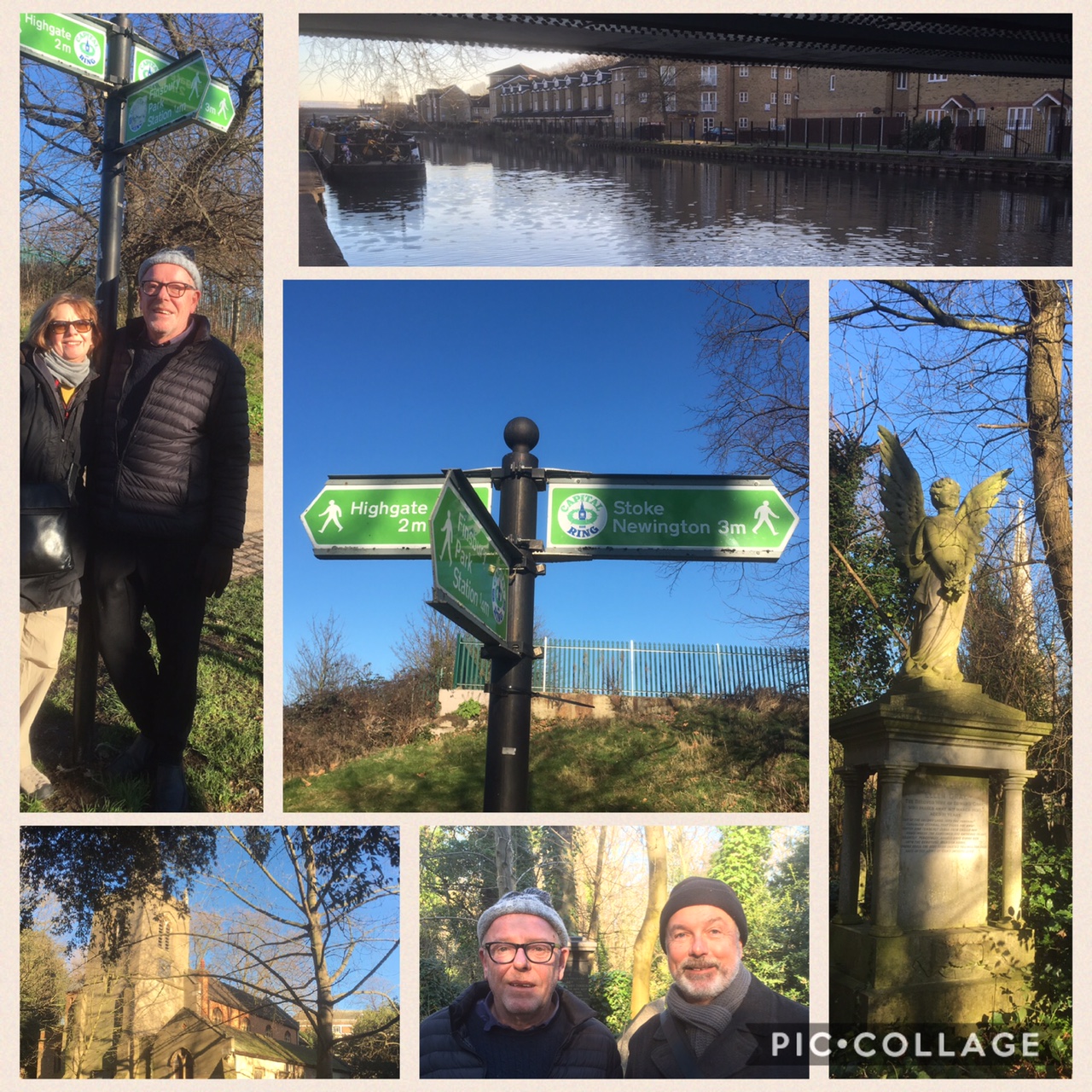
     We started this last Friday with the first 7 miles from Finsbury Park, accompanied by Gail.  We had chosen a brilliantly sunny but cold day for it, ideal walking weather. We are very familiar with the first section of this: the park itself, then to the excellent new wetlands at Woodberry Down, where the lake was full of water birds, including subathiing cormorants spreading their wings.  Then to Clissold Park and yummy mummy territory in Stoke Newington, and we took a swing through Abney Park Cemetery, looking less spooky than usual in the sparkling sunlight.
     Next, into unfamiliar districts.  A walk along Cazenove Street was a bit of a surprise.  This seems to be dominated by Jewish and Muslim institutions and was full of young men either in shalwar kamiz or silk frock coats and fur hats on their way from the mosque or to synagogue.  Quite a culture clash but everyone seemed to be quite content and used to it.  After this we came to Springfield Park, which is on a knoll giving a wide view across the Lee valley and into Essex.  From here, we followed the River Lee navigation for several miles.  Very pleasant, lined with narrow boat homes (increasingly popular, not surprisingly given the absurd rents these days) with the sun bright on the water. The water meadows were once a major food source for London. Hay was cut, then cattle grazed in the summer, then it flooded in winter, enriching the soil each year. It was and remains a major source for the city's water supply.  It's also an important recreation resource, with a world beating 80 football pitches on Hackney Marshes. 
     We found an on-trend canalside bar frequented by the local hipsters, No 90, and had possibly the best scotch eggs ever, made on the premises and served straight from the frier, washed down with a craft pale ale of course!
     A promising start to our trek. More pictures here. I'll continue to update flickr as we continue. 

Saturday, 7 January 2017

The Beach (again!)


     After a very sociable holiday period back in London and nearby, it's off to the beach!
2016 was a year of beaches: the dunes of Maspalomas and the French Atlantic coast; the powder soft white sands of Arcachon and Languedoc; the debris strewn coasts of Oregon and right across the Pacific in New Zealand; the rain battered strands of west Ireland; the municipal promenades of Margate and Southwold; the coral lagoon of Rarotonga; and best of all, that perfect unpopulated crescent of Bang Sak beach, lapped by the Andaman Sea.
     So where better to start 2017 than Fuerteventura, which is pretty much all beach when it isn't volcanic wasteland? A good antidote from Christmas excess as once more we stride along the soft, sandy seashore in a stiff breeze straight off the Sahara, the ocean waves crashing in, the sea shading from aquamarine to indigo under a china blue sky and a smiling sun. Ah, but here's that little beach bar with the rather good Estrella on draft...

Showtime


     It's been a good time to catch up on London cultural life. Best of the shows? Two stand outs: the first is on tour and I imagine the second will be on again soon:
  • The Rent revival, with ex-Billy Elliot Layton Williams stealing the show as radical dancing queen Angel. This story of struggling artists in NY's Alphabet City in the late 70s/early 80s at the height of the AIDS crisis was an emotional experience when I saw it 20 years ago, having lived on the fringes of 'bohemian' London at the time. This new, more intimate production is even more intense: in fact, we've booked to see it again when it hits Bromley, hankies at the ready!
  • An astonishing solo performance by Mark Lockyer in Living with the Lights On at the Young Vic, an autobiographical piece about his bipolar meltdown. A real tour de force in the writing and acting, as he slipped rapidly into the many characters he encountered at the time.
     We also caught a couple of good concerts: at the Wigmore Hall – brilliant Mozart piano sonatas from Francesco Piemontesi (who kept going despite a whistling hearing aid in the audience) and a good old Christmas medley (medieval to modern) from my choir at St John's priory.
     Sadly, no panto, non traditional or otherwise, at the Park Theatre this year.