Wednesday, 29 May 2013

If it’s Sunday it must be Venice; Italy: May 2013

Four good friends - Venice


It was Joel and Paula’s idea.  Let’s meet up in Italy for a short break.  Sounds great, I said.  We can fly direct from Newark to Milan, they said.  Milan: are you sure?  Well, while we are there we can visit the lakes; and Verona; and the coast… and how about Venice while we’re at it?

So Ian and I hopped on a plane to Milan late in the evening.  J and P had arrived a day earlier and had already ‘done’ Milan and Lake Como.  We only had time for a late night drink.  We had rented a car for the next day.  The rental office was somewhere in the vast stone pile that is Milan’s Central Station and it took a while to find it.  But pretty soon we were off and heading for Verona, straight down the autostrada, the Alps unrolling on the left as we sped past the endless lorries.  Verona markets itself as the city of Juliet; ‘If you love someone bring them to Verona.’  But peel away the tourist stuff and a very respectable and attractive city emerges.  Layer upon layer: a Roman core with its huge arena, being prepared for the summer opera season; and a large number of prosperous medieval and renaissance villas.  The winged lion of St Mark, on a pillar in the main square, marks it out as a city state under the thumb of Venice at the height of its power.  We route marched J + P for miles around the centre, so much so that their footwear gave way!

Next day Ian and I took it easy in Milan, while J + P were up for a 6:30 start – a roundtrip to the hidden coves along Italy’s north-west coast.  Milan has a very prosperous feeling to it, especially within the old medieval town.  Dolce e Gabbana and Versace shops on every corner.  The cathedral, royal palace and its huge square – all, it seems, recently magnificently restored – show the self confidence of this city.  The northern Gothic style of the duomo sets it apart from Florence, Rome and the south.  There is a sense that now and always, Milan has looked for its inspiration across the Alps rather than to the peninsula; just as there is something almost oriental and eastward looking about Venice’s San Marco.  We spent a pleasant, sunny day wandering the streets, and later at the Castello Sforzesco built on a huge scale and with an extensive park, attractive in early summer sunshine.  Joel and Paula, not content with a 12 hour coach tour, were looking for some evening action.  We found a very traditional restaurant with a garden, where we had a relaxing meal; then tried to get into the main square where there was a free concert – but it was completely packed out, so we retreated to the hotel for a nightcap after a circuitous metro ride. 

So – Sunday, and time for Venice!  We went by train, a comfortable two hour journey.  The arrival at Venice is one of the best.  Over the causeway, the vast lagoon stretching out, dotted with islands, and with the leaning spires of the city coming into focus ahead.  Then straight out of the station onto the start of the Grand Canal and into a water taxi, which whisks through the back canals between ochre stuccoed palaces, then out onto the wide, glittering stretch of water that separates off the island of Giudecca.  Ahead, the hotel that Joel has kindly booked us – the Stucky, a very tasteful conversion of a brick factory building.  This is probably the best city hotel I have ever stayed in.  The rooms are huge and with views across to the whole sweep of the main island, including the bell tower of San Marco, and beyond, on this exceptionally sunny and clear day, the wall of the Alps far off on the horizon.  An afternoon, an evening and a morning only: but we make the most of it, visiting not just the major tourist haunts around San Marco, but also the quieter streets around the Arsenale and the Via Giuseppe Garibaldi, which still has local shops and a real feel. We took the public water bus all the way up the Grand Canal then looping through the docks back to the hotel.  We are again lucky to find a hidden garden restaurant, in the little piazza by La Fenice, and tuck into some great Italian food, which is somehow always better in Italy!

We achieved a lot in a few days, and thanks so much to the indefatigable Paula and Joel for suggesting it and providing such good company and plenty of New Jersey humour! 

Songkhran soaking - Chiang Mai, April 2013

Calm before the storm: at Wat Doi Suthep
 After a few months back in London and initially enjoying lots of theatre and concerts, and even the snow, I found that the fag end of winter was dragging on and on, deep into April.  Lashing rain, bone-chilling gales… 

So thoughts returned to the embracing warmth of SE Asia once again.  And if thoughts, then why not deeds?  Idly searching the likes of opodo and lastminute.com one day, I found that flights to Chiang Mai could be had surprisingly cheaply.  Having survived the Loi Krathongfestivities, and realizing that Songkhran was on the way…

Songkhran: the Thais’ new year; and though they also celebrate the western and Chinese equivalents, this is the biggest celebration in the calendar.  The citizens of Chiang Mai are recognized throughout Thailand as the best partiers in a partying nation, and this is their high point.  So it was obvious what I had to do.  And I did.

In no time I was whisked from grey, drizzly Heathrow at a fridge-like 4 degC, and found myself standing in a warm sunset glow at Chiang Mai, in the high 30s, with a distant view of the local mountains, blue silhouettes against a red afterglow.  Welcome once more to the Land of Smiles: certainly there was a big grin on my face!

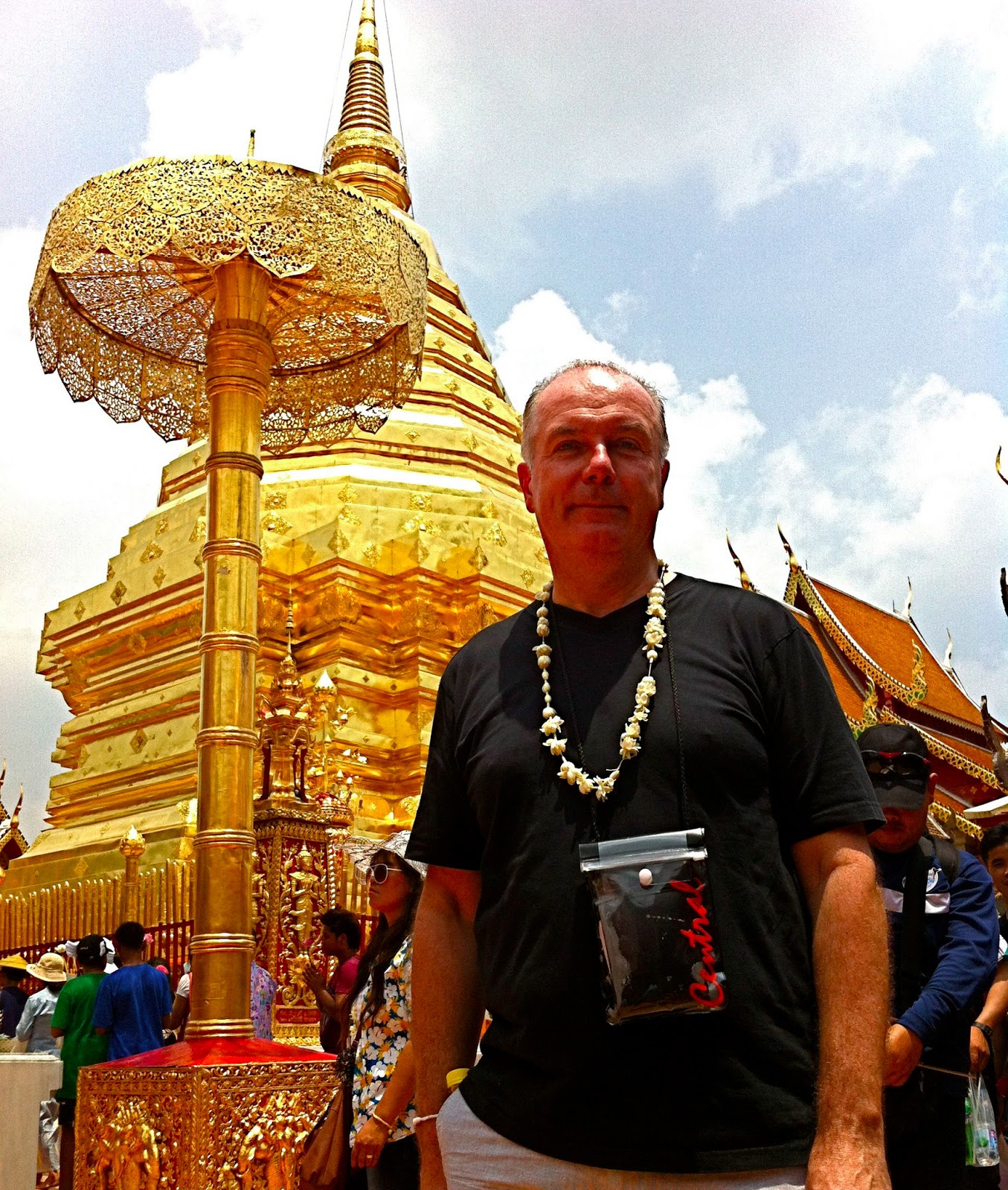
I was welcomed into the little B+B by the Thai-Brit couple that run it, and felt immediately at home.  For the festival I made my base at a nearby bar on one of the main streets, a tiny but very friendly place, where they were very keen to initiate me into the mysteries of the festival.  I later met the owner of the bar, who turned out to be an American transsexual with, it seemed, a beautiful local girlfriend (a real woman as far as I could work out).   Only in Thailand!  One of the bar staff, Sak, took me under his wing and determined I was going to get the most out of the new year.  Early one morning, he took me up the mountain on the back of his underpowered motorbike (I had to get off and walk the last bit!) to the temple of Doi Suthep, which is one of the most important religious sites in the country.  On this, the first day of the holiday, it was packed with local people coming to pay their respects.  We bought candles and incense then walked three times around the central stupa, its solid gold cladding dazzling in the hazy early morning light against a Gaugin-blue sky.  Then we knelt as an ancient tattooed monk in his tangerine bright robe blessed us and flicked water across us. 

This is the origin of the water festival, a respectful and religiously based gesture.  In the past, people would pour a small libation from a cup over your shoulder to wish you good luck.  Little did I know how this had metamorphosed over the years.  Though perhaps I should have guessed, given my Loi Krathong experience, where a calm tradition of floating candles on the river had turned into a mad firework throwing event across the whole city. 

So back to the city streets, and things were already kicking off at the bar.  Sak took me walking round the full perimeter of the moat of the ancient city, and the streets were filled with stalls and pick up trucks. Not a water festival – a water throwing festival!  The stallholders were not so interested in selling as dragging buckets of warm brownish water from the moat and flinging it at every passer by – especially the farang!*  The crammed beds of the pick ups were full of giggling kids with monster water pistols – and no feeble western types: think Kalashnikovs of the water spraying world – which they constantly refilled from barrels of ice water.  So you could simultaneously be getting a freezing face full from the left and a warm drenching from the right, over and over again.  All delivered with mischievous smiles and cheers!  I was completely soaked within seconds, but still it kept coming.  Then as we headed back towards the bar, the gods decided to join in.  With a huge echoing crack of thunder, an unseasonable monsoon-style deluge fell from the huge black clouds that suddenly appeared over the city, drenching everyone yet again. 

Two more days of this!  One evening I made the mistake of asking Sak to take me on his bike to a restaurant on the far side of the city, thinking things would have calmed down later in the evening.  We had to run the gauntlet of a thousand grinning kids and again arrived soaked.  This wouldn’t work in London, but in temperatures in the high 30s (90s F) it was good fun; and I ended the three days with a rictus grin.  Battered but very happy I retired to the bar and ordered a stiff gin and tonic.

*foreigners

Sunday, 23 December 2012

Photos now on flickr

I have added photos on flickr for the first part of our trip
at:
http://www.flickr.com/photos/keithuk/sets/

luang prabhang

     The ancient city of Luang Prabhang is set on a misty, mystical, promontory surrounded on three sides by deep river valleys, then in turn by range after range of pale mountains rising to ever greater heights.  The whole landscape is suffused with wood smoke and a feeling of peace, calm and dare I say spirituality.  This is helped by the monks who are all over town, on mysterious missions.  Old monks and young monks, some maybe only 7 years old, in their orange robes or yellow robes – each wat has its own subtly different design – walk calmly on the roads with their forage bags over their shoulders.
     The town, a world heritage site, has been for the most part carefully managed, and has many small French colonial buildings, and new buildings are very much in the style of – verandahed and tile roofed and white painted, never more than two storeys – so that the wats still dominate the view.  It does still have the feel of a real town, with chickens running everywhere, cocks crowing, rice and chillis drying in big wicker bowls in the sun, though inevitable tourism is taking over.  In only two years since my last visit there seem to be more and larger hotels in the centre.  Once it was almost entirely very small family run businesses – a few rooms above a shop house.   
     We stay in a small Australian owned hotel, which is mostly new built (although our huge and stylish room is part of an older house incorporated into the rest).  It’s built round a small courtyard, shaded with big-leaved shrubs and bushes.  Great for breakfasts and afternoon cooling drinks.  The staff are very pleasant and eager to chat, working on their conversational English.  Almost all of them are studying part time, English or hotel management.

     In the evenings, the sun sets over the Mekong, sometimes spectacularly, as the tourists sip their cocktails at the improvised little open air bars.  The dark descends and there is an almost reverential hush around the town, even in the tourist streets.  The lights are dim, the stars shine out clear in the black sky.

     4am and there is a distant rhythmic drumming. The monks at the nearby wat are being roused: still pitch dark outside. 
     4.30am: a cock crows.   
     5.00am: sounds of pots and pans being briefly banged together.  It’s time for the daily food giving.  I peep out of the shutters.  The old ladies from the houses opposite are kneeling beside the road, in their traditional Lao long skirts, with bowls of sticky rice, and the procession begins.  Groups of monks from each wat pass them in single file, and into the metal bowl carried by each, the ladies place a handful of sticky rice.   
     Each group, in their bright orange robes is led by a senior monk, but most of the rest are juvenile with seemingly the youngest at the rear.  The robes are slightly different to mark out each wat: about 10 or 12 from each wat.  All done in complete silence in the grey predawn light.  There are lots of wats and the process lasts some minutes: then suddenly it is over and the ladies are packing up for another day.  Back to bed for me and perhaps a little peace until breakfast time.

     Is there a danger of a place like this becoming a victim of its own success?  The peaceful little dawn ceremony is nowadays punctuated by camera clicks and flashes.  More of the real inhabitants are pushed out by newer, bigger hotels.  The guidebooks tell you to do this at this time, that at another time.  As a result these particular experiences become overcrowded and the wonder is lost.   
     The eternal travellers’ dilemma: am I destroying the thing I came to see?   
     At sunset, the guides advise a trip to the temple at the top of Phou Si, the steep hill in the centre of the peninsula.  So everyone troops up there.  At the top is an important religious site, That Chomsi, but the tourists are oblivious; they turn up in their singlets and bikini tops, they talk loudly and take endless pictures of each other for facebook, they chat about where the cheapest place to get drunk is; and all the while in the background the sun sets sedately behind line after line of smoky mountains fading into distance.  The sun sets and instantly the tour guides raise their flags and the larger parties are off.  We stay behind to see what is in fact the best bit, as the sun’s final rays highlight each layer of cloud, higher and higher through orange, red and then finally to grey.  The sky continues to glow long after, as the few lights in the landscape flick on, the barbecue fires send up their offerings, the stars start to emerge in the rapidly dimming sky, the air becomes still and distinctively cooler.  This could have been a spiritual experience, but almost everyone misses it.

chiang mai 2

      Chiang Mai’s ugly modern hinterland continues to grow, but its old centre continues to retain its attractions.  A big square moat and remnants of its walls form a rectangle, filled with little lanes and temples, while outside the moat runs a major racetrack road which draws most of the traffic away.  I suppose the centre is now almost entirely given over to tourism, apart from the temples of course, but it still retains its charm.  There are little boutique hotels, spas, second hand book shops and coffee houses.  Some of the best of the wats are the oldest ones.  This was once the capital of the northern Lanna kingdom, and at its centre stands a huge, ruined, but still impressive chedi in one of the larger religious compounds.  These places are an odd mix of the spiritual and the banal.  The ancient carved teak temples contrast with the cafes and school rooms and car parks found within the walls. Monks chant and drum long into the night; or tune in to their ipods in shady corners in the heat of the day.  People make fervent obeisance before a golden Buddha image; or give packages of foods wrapped in cling film to the monks; or chat loudy and raucously; or try to sell you postcards. 
     It’s a great town to walk around at random and just see what you come across, and there’s a calmness about the place (now that Loi Krathong has ended!).  There’s also some great countryside nearby, once you get past the ribbon development along the arterial roads.  Looming over the city is the great mass of Doi Suthep, with its golden temple and royal palace.  We hired a car and drove a great loop round behind this mountain, to the beautiful densely wooded hills  and eventually to the pretty village of Samoeng.  It’s poor and relies entirely on agriculture, but the people obviously take a pride in the place.  There’s a very well kept public park and unlike many Thai villages, an air of tidiness.   
     Another day, we took the trip to Doi Inthanon.  Travelling out of Chiang Rai towards Lamphun along a road lined with mature trees (which is much more pleasant than the other routes into the city, lined with car repair workshops and furniture showrooms), you cross fairly unexciting agricultural land until you turn off the main highway.  Then suddenly you are into the national park and rising continuously mile after mile towards Thailand’s highest point.  This is also a rather sacred place for Thais, and has been heavily invested in with projects to help the local hill tribe populations.  There are lots of market gardens amongst the forested hills, and roadside markets with fresh salads and dried fruit.  Passing the pair of modern chedi dedicated to the king and queen, you eventually approach the summit.  The temperature here is almost chilly, perhaps 20C less than in the plain below.  The trees moss encrusted and wizened, often in cloud, and you come to the little altar with a plaque announcing the height above sea level (accurate to 1/10 of a millimetre!).  They grow good coffee up here too and we sample a cup at the Vatchirathan waterfall, just as the rain starts to pour down for a brief spell.  Suddenly – the chill and the mists and the rain – you could be in the Pennines!  Although the banana trees are a bit of a give away. 
     So back to the city for a meal at one of several old teak houses we visited, set in its own gardens – pleasant food under the stars and the moon, now past full and on its back, recuperating no doubt from the earlier festivities. 

Monday, 3 December 2012

chiang mai 1

        It’s Loi Krathong and the entire population of Chiang Mai has gone mad.  I’ve always said the Thais know how to party, but this?  My understanding is that Loi Krathong – or more correctly called Mee Ping here in the Lanna Kingdom of the north – started as a gentle propitiation ceremony for the water goddess, where people placed little bamboo rafts bearing candles and incense on the river, to take away bad luck for the coming year, at the time of the full moon.  How this turned into a violent fireworks party where smiling parents let their little kids light rockets in their bare hands and chuck them across the river I have no idea.  Throw in an assortment of bangers, any number of much bigger more formal star shells, some of them aimed directly at the buildings opposite, and thousands of sky lanterns, so that the sky is filled with moving constellations of orange lights all over the city, and you get the idea.  Sorry, Lewes, you really have to try harder. 
-->
        Health and safety is not the Thais’ strong point.  Having fun is what it’s all about.  To be fair most of the hand held rockets are tiddlers that fizzle and sputter a few seconds then die; but you have a few thousand people all simultaneously lighting armfuls of them one after the other, swinging them round and round by their sticks until they start to sizzle, then launching them overarm into the air (or often missing and having them whizz across the street or under the wheels of a car, to great hilarity).  We got into the spirit of course, and launched our gaily decorated little bamboo raft out onto the grey waters of the Ping, attempting to piously wish away our bad luck, while occasionally ducking to avoid a stray rocket.  Then we joined the crowds on one of the main bridges and launched our own sky lanterns.  These are paper and bamboo miniature hot air balloons that have a paraffin wax cylinder inside that you light, so that the hot air lifts them sedately into the sky after a minute or two.  Another fire hazard of course, as they jostle up amongst the overhead chaotic live wires and timber eaves of the houses – but it’s all good fun. 
        Back for Song Kran next year?  This started out as a celebration of the Thai new year every April, where as a mark of respect for elders a ritual libation of holy water was gently poured over them by young people.  I hear that water trucks and high pressure hoses are now involved…

chiang rai

        So to the far north of Thailand.  Chiang Rai is a sleepy trading post with not a lot to recommend it, except a night market with as at its heart a huge open air food court.  I suppose it would once have had an exotic air, with mysterious hill tribe people trekking for days to bring their produce: village-grown coffee, tea and herbs –  and maybe opium under the counter; leggy chickens, floppy-eared pig heads and unknown species of river fish; ethnic clothing intricately woven from vegetable dyed yarn.  Some of this you can still find, but now it’s mostly tourist nick-nacks, and for the locals, car parts and rip-off DVDs.  Still lots of mysterious hill tribe faces though, Burmese and Tibetan and Chinese: tiny, ancient, shyly spoken ladies in gaudy bonnets, and edgy looking young men in bobble hats sharing a large bottle of Chang beer. 
        But we have elected to stay in a resort style hotel a little way from the centre, very upmarket but cheap at this unseasonal time of the year. As in the south, the rains are lingering on much longer than normal, so the weather is distinctly mixed with some huge downpours but mostly dry and calm.  It’s not bad enough to keep us away from the layered pool, dropping down, infinity edge after edge, down towards the muddy river Mae Nam Kok.  The gardens are immaculate and the hotel buildings have been built around two huge old jungle canopy trees that shade the courts.
        We decide to explore further and drive up into the mountains near the Burmese border, passing through some of the corrugated iron roofed villages high up on the ridges that run through this area, the last knockings of the Himalayas.  Not a scrap of flat ground: it’s all hills, mostly wooded, but some clearings with steeply sloping tea plantations in neatly clipped rows, others with a few terraces of hill rice, scraping a subsistence living.  Ridge after blue smoky ridge ahead of us: the infinity edge of Thailand.